Chemical & Physical Peptide Evaluation
@beaueeqc172
Peptide Pureness Guide 98%, 99% & Research-grade Discussed Prg
Straight from the synthesizer with very little processing-- generally just cleavage from the material and precipitation. Purity varies extensively, from 40% to 80%+ depending upon sequence length and problem. Crude peptides appropriate for applications where purity isn't critical, such as antibody production or initial screening assays where the target peptide just needs to be present, not dominant. Carefully related to truncations, deletion peptides are full-length chains that are missing out on one amino acid somewhere between. If capping isn't flawlessly effective, an uncoupled chain can continue to elongate in CJC-1295 DAC subsequent steps, generating a peptide that's just one deposit except the target.The pureness of peptides is usually checked using high-performance liquid chromatography (HPLC). HPLC separates peptides based upon their communications with a fixed phase, enabling impurities and byproducts to be determined and measured. In addition, mass spectrometry (MS) can be used to Get more info confirm the peptide's molecular weight and sequence, supplying further confirmation of purity by discovering pollutants and degradation products. If you have actually ever acquired an artificial peptide for a lab experiment, you have actually likely saw a pureness percentage on the certification of evaluation-- usually worths like 95%, 98%, or perhaps 99%. Peptide purity is a crucial high quality metric that tells you what portion of a peptide example is the designated product versus undesirable byproducts.
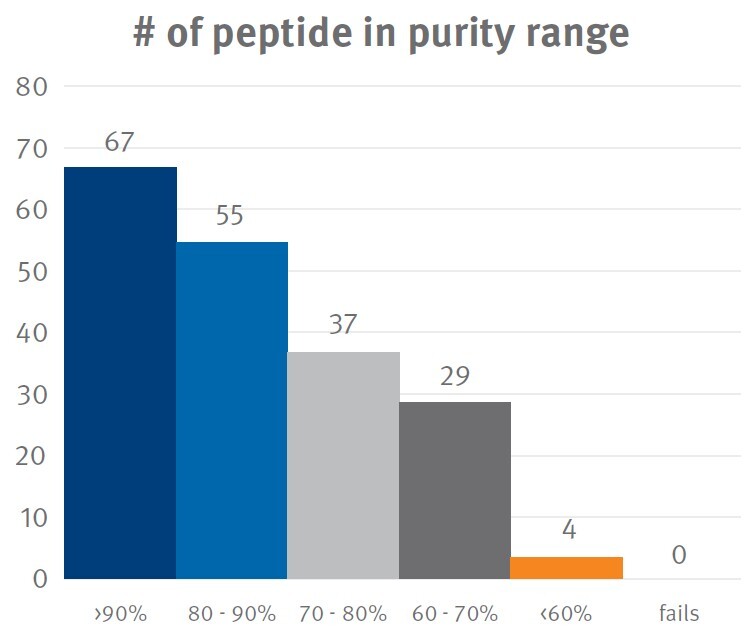
Peptide Purity Analysis Service
- This degree of detailed analysis ensures the peptide's accuracy-- meaning the series and pureness are exactly as classified-- which is essential for speculative reproducibility.
- In vitro examinations evaluate peptide cytotoxicity, cell uptake, anti-inflammatory activity, and more, supplying essential data sustain for peptide applications in clinical looks and biomedical areas.
- Each peptide has a different anticipated molecular weight, so mass confirmation is not a generic badge; it is compound-specific proof.
- Creative Peptides proposes a series of various purity degrees to help you select the ideal peptide purity for peptide-based assays and applications.
- Peptide pureness refers to the portion of your example that is the proper, unabridged peptide sequence, without various other peptide-related contaminations.
If the COA notes "total pollutants", that enhances the pureness number (e.g., 98% purity implies 2% total contaminations). Several COAs also define known or "defined pollutants" versus undefined ones, each with their private percentages if over a certain limit. This level of detail helps scientists recognize if any kind of small peptide by-products exist. If you see multiple big tops of comparable elevation, you're taking a look at either a low-purity sample or a blend. If the primary peak has a noticeable "shoulder"-- a bump on one side-- that often shows a very closely related impurity (like a deletion peptide) that the column could not totally deal with. The peptide is travelled through a straightforward purification action (frequently gel filtration or a quick reversed-phase cleanup) to remove salts, small-molecule byproducts, and scavengers from the bosom step.
Efficiency Cookies
BOC Sciences uses thorough peptide screening services to customers throughout sectors, ensuring items satisfy rigorous market requirements and ensuring item uniformity, safety and security, and effectiveness. It also sustains traceability-- each batch's laboratory validation report can be linked to its COA and regulative filings, developing a clear paper trail. Simply put, extensive lab validation is exactly how you prove to regulators that your peptide meets all quality specifications. It aids avoid conformity concerns such as stopped working audits or product recalls because of top quality issues. This not just pleases lawful demands yet inevitably protects person security.

Our Peptide Chemical & Physical Evaluation Services
Significantly, this purity number is usually established after purification (e.g. by HPLC) and concentrates on peptide contaminations-- it doesn't count residual water, salts, or counter-ions in the dried out peptide powder. In other words, the purity percent has to do with the make-up of peptide types in the example, not the weight payment of water or salts. A peptide can be 98% pure (implying very couple of peptide contaminations) yet still contain some water or trifluoroacetate salt; those non-peptide components would be reflected in the web peptide material as opposed to the pureness percentage. At Creative Peptides, we give customized peptide chemical and physical evaluations for study teams that need reputable information on peptide identity, purity, make-up, service habits, and example quality. Our service sustains artificial, modified, cyclic, conjugated, and tough peptide samples with analytical operations built around the actual project concern rather than a fixed default panel.
Nevertheless, attaining ultra-high purity (say 99%) can be practically challenging and might not constantly be needed, as we'll discuss later on. The key is understanding what level of pureness suffices for your requirements and how pureness is established in the first place. For many study objectives, high pureness suggests you can be certain that the huge majority of the molecules in your vial are the appropriate peptide, which helps guarantee speculative consistency and reproducibility. Our workflow is designed to move from example context evaluation to interpretable peptide data with minimal analytical obscurity. Tasks can vary from one example identity check to multi-lot comparability, residual testimonial, solubility assessment, or stability-focused analytical packages. Hydrophobic peptides, extremely basic series, customized constructs, and closely associated analogs can be examined with method adjustments matched to their logical threats. Each peptide has actually a various anticipated molecular weight, so mass confirmation is not a generic badge; it is compound-specific evidence. For a deeper identity-focused description, see Mass Spectrometry Peptide Verification. Identity testing confirms that what was synthesized is actually the intended series.